The story behind our reconstructions
The building at the heart of ancient Jerusalem stood for roughly three and a half centuries, from its construction under King Solomon around 960 BCE to its destruction by the Babylonians in 586 BCE. Nothing of it survives above ground today. The site itself, the Temple Mount, is now one of the most closely watched and carefully managed places on Earth, and standing there gives no sense of the building that once filled it.
TimeLens brings it back with Ofer Becker of Becker Innovation. Working from the detailed descriptions left in ancient sources, among them the Hebrew Bible, the Mishnah tractate Middot, the Talmud and later rabbinic commentaries, read here as historical documents for the building's measurements, materials and layout, in the same way we use the Castello Plan for New Amsterdam or classical accounts for Athens. Stand at the site, raise your phone, and see the Temple restored around you, its cedar, bronze and gold set out where these texts place them.
What makes this reconstruction unusual is how precisely the building survives on paper. Ancient sources give measurements down to the cubit for its walls, gates, courts and altar, checked here against more than forty separate texts, which lets the model be built to scale rather than impression, from the public court at the edge of the compound through to the small chamber at its centre.
The TimeSpots in Jerusalem
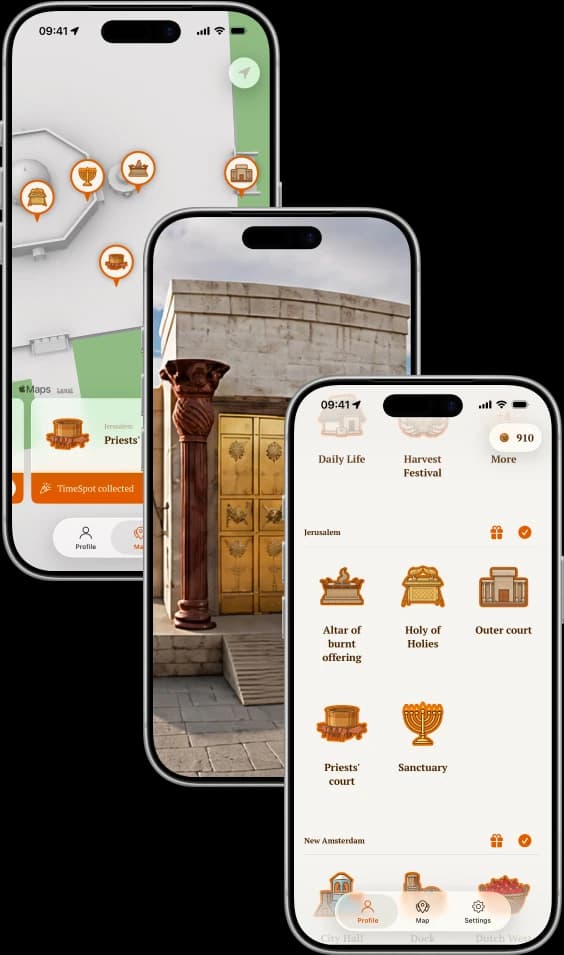
Each TimeSpot is a real place within the Temple complex where you can stand and see the past restored in full, 360 degrees around you. Travel to a spot to unlock it, then look around the scene at your own pace. The map shows every TimeSpot, and new ones are added as the project grows.
-
The Outer Court (Chatzer haChitzon)
See the great public court where the compound began, entered through cedar gates faced with bronze and lined with palm trees. -
The Priests' Court (Chatzer haKohanim)
Stand at the inner enclosure set aside for the priests, marked off from the public court by a high stone wall and three gated entrances. -
The Altar of Burnt Offering (Mizbach haOlah)
See the great altar covered in bronze at the centre of the Priests' Court, where the daily offerings were made and a fire was kept burning without pause. -
The Sanctuary (Heikhal)
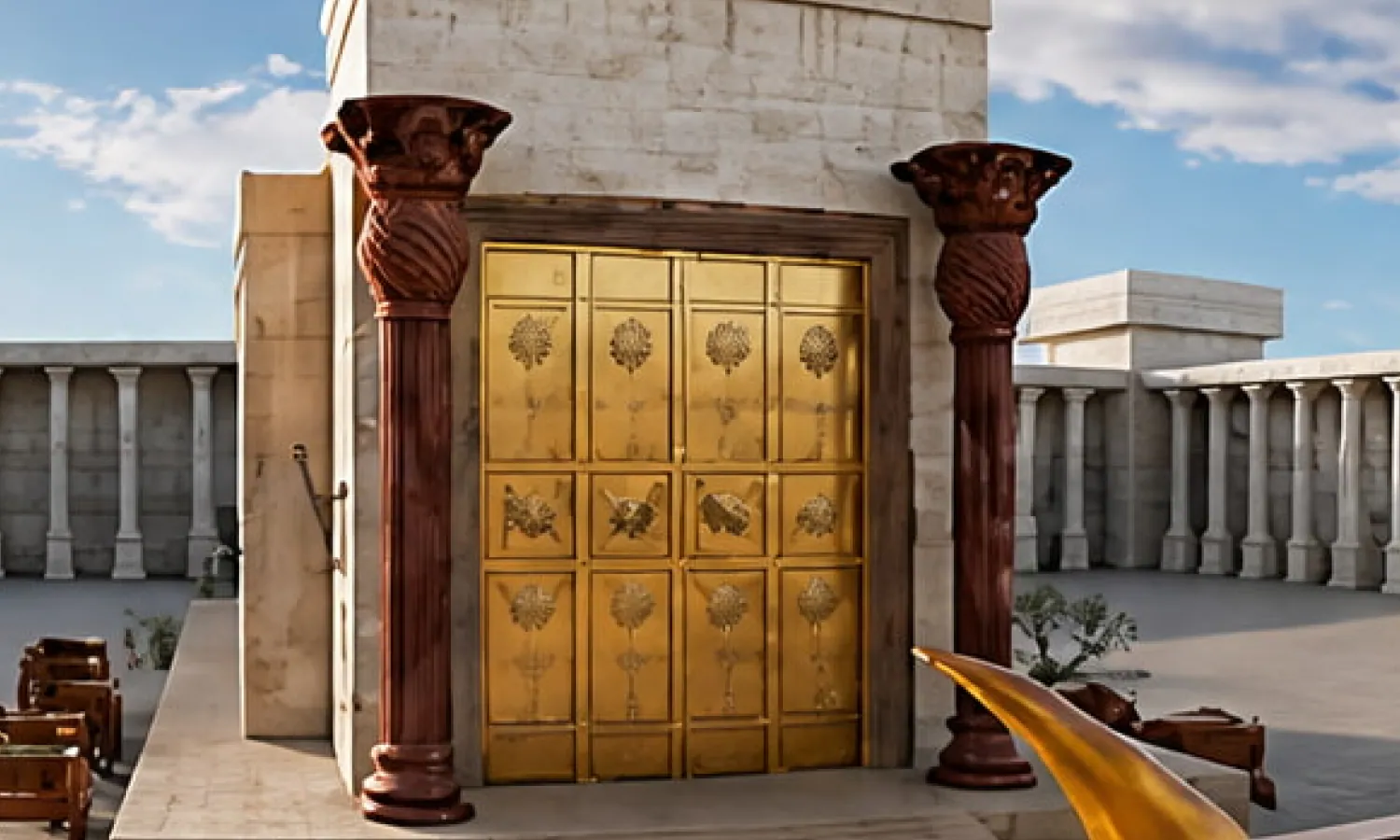
Stand in the main hall of the Temple and see the golden lampstand, the showbread tables and the altar of incense, set out as ancient sources describe them. -
The Holy of Holies (Kodesh haKodashim)
View the small inner chamber at the heart of the building, screened by a woven veil and, according to temple tradition, home to the Ark of the Covenant beneath two great golden cherubim.
Based on historic research
The experts behind the Temple reconstruction
Every TimeSpot in the Temple complex is based on the reconstruction created by Ofer Becker of Becker Innovation, so each scene rests on years of textual research rather than guesswork. The model draws on ancient sources including the Hebrew Bible, the Mishnah tractate Middot, the Talmud and later rabbinic commentaries, checked here against 42 ancient and rabbinic texts and more than 240 individual references in total, to reconstruct the compound to scale.
The historical accuracy was guided by the expert consultation of Dr. David Jeselsohn, whose expertise contributed significantly to the reliability of the presentation.


How to use TimeLens
Step 1: Travel to a TimeSpot
Make your way to one of the historic locations shown on the map. Once you arrive, it automatically unlocks the TimeSpot for you.
Step 2: Look around
Hold up your phone and take in the scene in every direction. A 360-degrees historic reconstruction of the city full of life.
Step 3: Collect rewards
For each location you discover, you receive a badge and some TimeCoins as a reward. Discovering combinations of TimeSpots even gives you special awards.

.png)
.png)
.png)
Want to help us create more of these reconstructions?
Every reconstruction takes months of research and craft. A small amount each month helps us build more of them, and brings you along for the journey, with early previews, behind the scenes insights, and a say in which places we bring back next. You can even have your name featured in the app, or appear as a figure in a future scene.