The Theatre of Dionysos: Where Medea Took Flight
Imagine standing in the Theatre of Dionysos in Athens, around 320 BCE. The stone seats climb the south slope of the Acropolis, packed with spectators. It is a festival of Dionysos, and on the stage below, one of the most famous moments in all of drama is about to unfold. This is our newest TimeSpot, now in production, and it takes you to the very place where theatre as we know it was born.
A festival in full swing
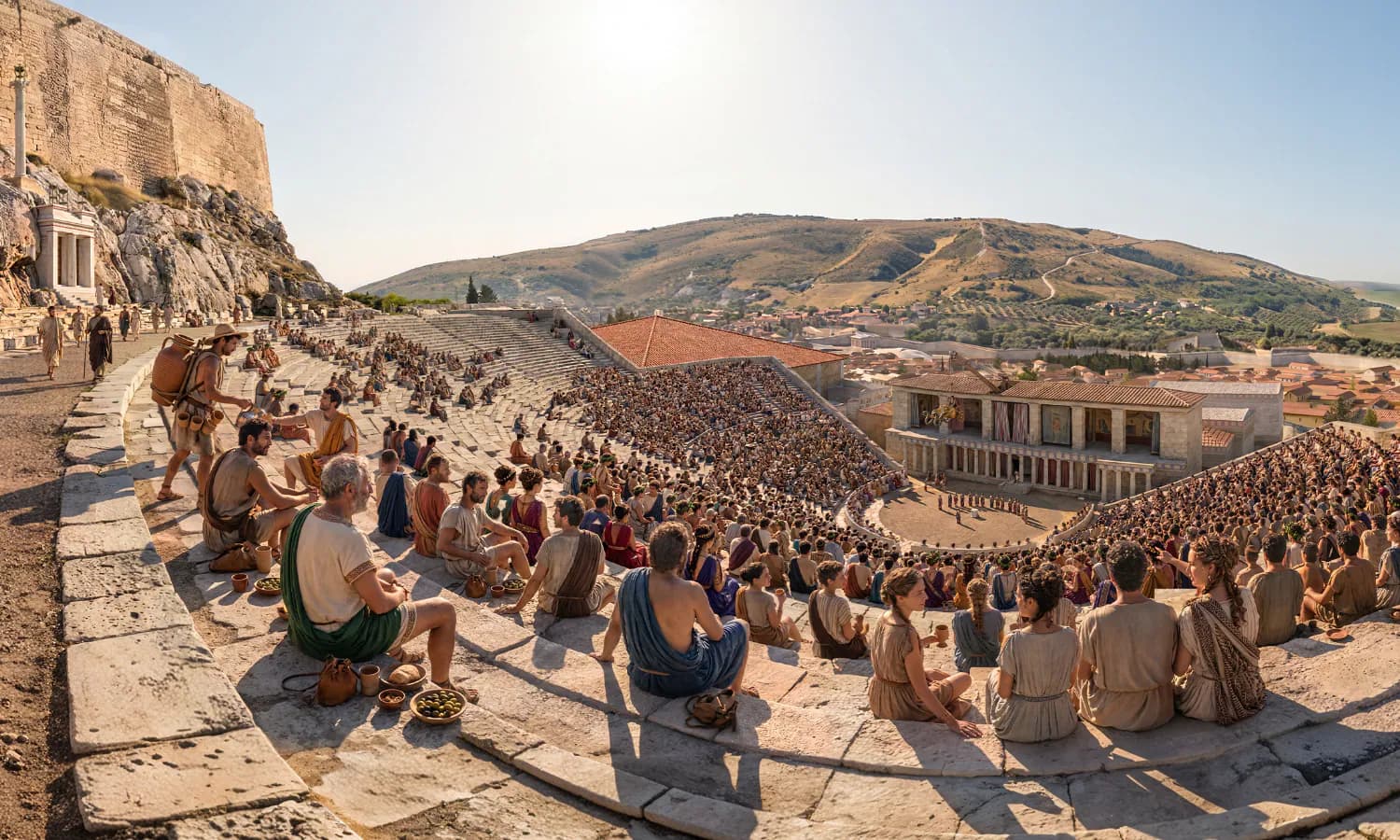
The Theatre of Dionysos was the beating heart of Athenian public life. This is where the great tragedies and comedies of Aeschylus, Sophocles, Euripides and Aristophanes were first performed, before thousands of people, during the festivals held in the god's honour. Plays that are still performed worldwide today.
Our reconstruction captures one of those festival days. The seats are full. Sellers move through the crowd with food and drink. Spectators share snacks, and a trader does a lively business in laurel wreaths for the audience to wear. Rising above the seating stands the Monument of Thrasyllos, erected in 320/319 BCE, which helps fix our scene precisely in time.
The most famous exit in theatre
On the stage, in front of the palace façade, we join the devastating climax of Euripides' Medea, first staged in Athens in 431 BCE and revived here as a classic. Medea rises into the air in her chariot, escaping by means of the mechane, the theatrical crane, as Jason stands below, left with their dead children. It is the definitive example of the deus ex machina, the "god from the machine," and the Greek theatre is where that idea, and that phrase, began.
Beneath her, in the round space at the foot of the seats, stands the chorus of Corinthian women. That space has a name you will recognise: the orchestra. The word comes from the Greek for a dancing place, the ground where the chorus sang and moved. It is one of many words this theatre handed down to us.
Grounded in the evidence
As with all our Athens reconstructions, this TimeSpot rests on an architectural model by Dimitris Tsalkanis, with the support of Professor Chrysanthos Kanellopoulos, and on the archaeology of the south slope. It joins our growing view of ancient Athens, alongside the Classical Acropolis just above it on the rock.
See it soon
The Theatre of Dionysos is available now in the TimeLens app. Download it to be able to stand among the crowd, watch Medea take flight, and hear a festival come back to life on the slope where it all began.
If you would like to follow the work and support more reconstructions like this, you can join us on Patreon. And if you represent a museum or heritage site, we would love to hear from you.