How the Parthenon Was Destroyed: The Explosion of 1687
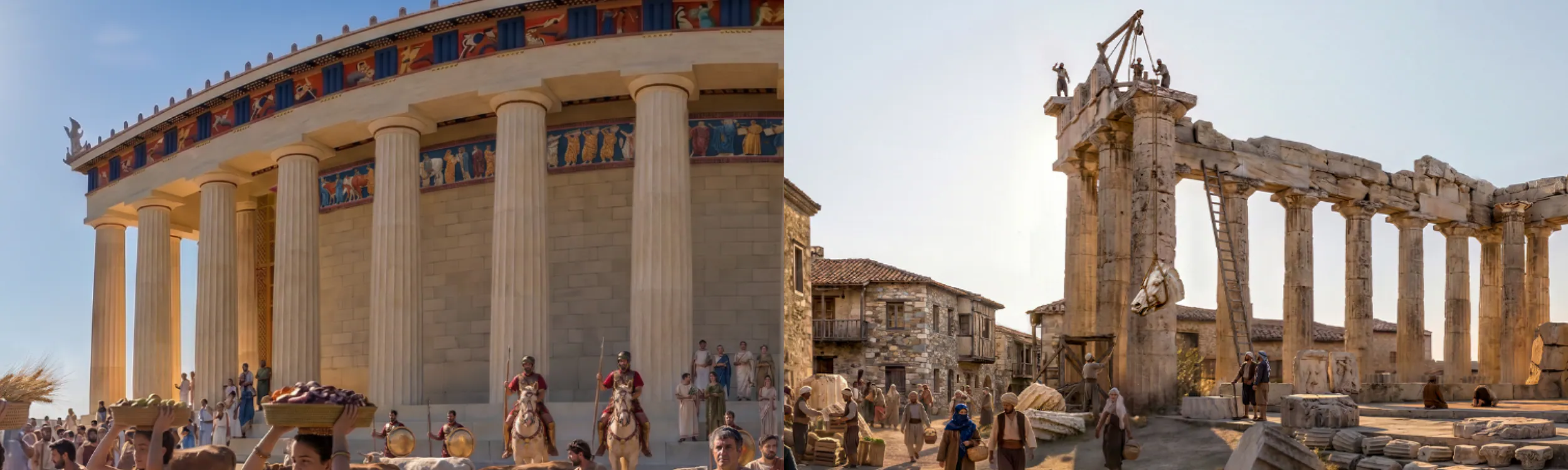
For more than two thousand years the Parthenon stood almost intact. It had survived as a temple, a church and a mosque, keeping its roof, its walls and nearly all its columns through war, fire and one empire after another. But today we see only a ruin, so how was the Parthenon destroyed?
A city caught in a long war
The Ottomans and the Venetian Republic spent much of the seventeenth century at war. In 1687, as part of the conflict known as the Morean War, a Venetian army under Francesco Morosini marched on Athens and laid siege to the Acropolis, which the Ottomans had turned into a fortress, a garrison town complete with the commander's residence in the old Erechtheion.
Gunpowder in the temple
The Ottoman garrison needed somewhere safe to keep its gunpowder and to shelter families from the bombardment. They chose the strongest, most solid building on the rock: the Parthenon, which had also served for generations as the Parthenon mosque. It was a fateful choice, and not one without warning. An earlier blast had already wrecked the nearby Propylaea decades before, a clear sign of what stored powder could do.
How was the Parthenon destroyed? The night of 26 September 1687
On 26 September 1687 a Venetian mortar shell arced over the walls and struck the Parthenon. The gunpowder inside detonated. The roof was blown away, the long walls of the inner chamber burst outward, and columns toppled. People sheltering inside were killed. In a matter of moments, a building that had stood for over two millennia was gutted.
What was lost
We know something of what vanished thanks to a French artist, Jacques Carrey, who sketched the Parthenon's sculptures in 1674, only a few years before the blast. His drawings are sometimes the only record of carvings the explosion destroyed. Worse was to follow. When Morosini tried to lower sculptures from the west pediment to carry home as trophies, the lifting tackle failed and the figures crashed to the ground and shattered.
The ruin we inherited
The Venetians held the Acropolis only briefly and abandoned Athens in 1688. The Ottomans came back to a wrecked Parthenon and, in time, built a smaller mosque among the ruins. The shape we now picture as the classic Parthenon, roofless and open to the sky, is in large part the shape this one explosion left behind.
See the Parthenon as it once stood
It is easy to forget, looking at the ruin, how complete the Parthenon once was. Using careful historical reconstruction, TimeLens lets you stand on the Acropolis and see it as it was through these centuries, before time and gunpowder reduced it to the shell we know today.