When the Parthenon Was a Mosque
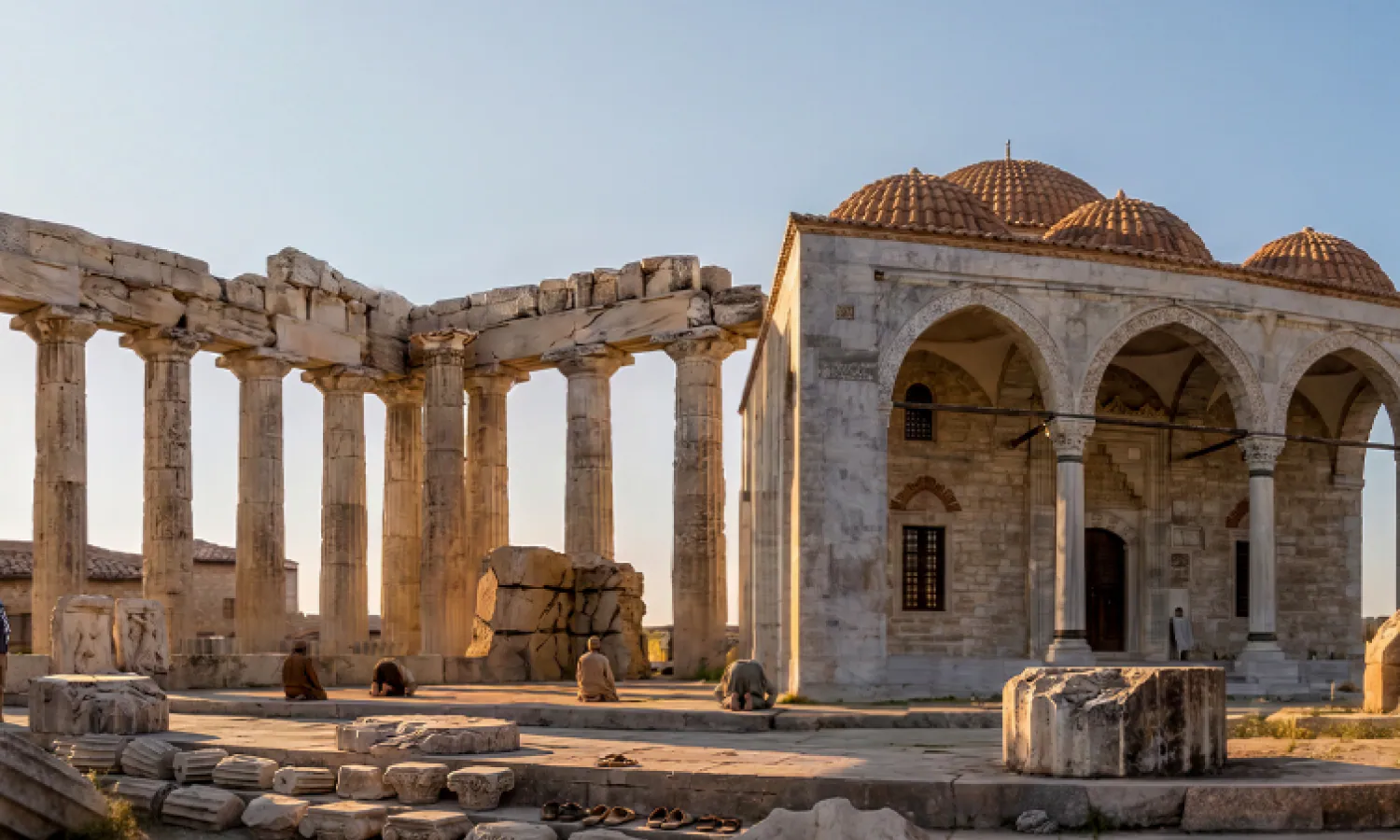
Imagine standing on the Acropolis three hundred years ago. The Parthenon rises ahead of you much as it always has, but a slender minaret climbs from its southwest corner, and the call to prayer drifts out across the rooftops of a small Ottoman town. For roughly two centuries this was the everyday Parthenon. Not a ruin, not a museum, but a working mosque at the heart of a living city.
The idea that there was a mosque inside the Parthenon surprises almost everyone. Yet it is one of the longest chapters in the building's history, and almost nothing of it remains to see.
From temple to church to mosque
By the time the Ottomans arrived, the Parthenon had already been many things. Built as a temple to Athena, it later served for centuries as a Christian church. Within a few decades of the Ottoman conquest of Athens in 1458 it was converted once more, this time into a mosque. The changes were modest. The Christian apse became a mihrab facing Mecca, a minbar was added for the imam, the painted walls were whitewashed, and the old corner tower, once a bell tower, was raised higher to become a minaret. The great structure itself stood almost untouched.
A wonder travellers came to see
In the 1660s the Ottoman traveller Evliya Çelebi visited Athens and marvelled at the building, describing it with real wonder. The European visitors who followed left some of the only records we have of the Parthenon while it was still whole. For most of this period the temple kept its roof, its walls and nearly all its columns, an astonishing survival after two thousand years. This was the heart of Ottoman Athens, a small provincial town gathered beneath the sacred rock. Nearby, the Erechtheion served as the garrison commander's residence, part of the daily life that filled the citadel.
The night everything changed
That ended with the explosion of 1687. During a Venetian siege the Ottomans were storing gunpowder inside the Parthenon, and an incoming shell set it off. The blast tore the building apart and left the ruin we recognise today. It is a story worth telling on its own, and we do, in detail, in a separate post.
A second mosque in the ruins
The Ottomans soon returned, and rather than abandon the site they built a smaller, separate mosque inside the shattered shell of the Parthenon. This second mosque stood for well over a century. Remarkably, it lasted long enough to be photographed. It appears in the very first photograph of the Acropolis, taken in 1839, a small domed building sitting quietly among the broken columns.
How the mosque disappeared
When Athens became part of independent Greece in the 1830s, attitudes shifted. The young nation wanted to be seen as the heir to classical Athens, and the later Ottoman, Frankish and Byzantine additions were treated as clutter obscuring that ideal. The minaret came down, the second mosque was demolished in 1843, the medieval Frankish Tower followed in 1875, and the houses that had covered the rock were cleared away. The Acropolis we visit now, stripped back to its ancient bones, is partly a deliberate creation of the nineteenth century.
Seeing the Parthenon mosque again
This is one of the stories we love most at TimeLens, precisely because so little of it survives. Drawing on detailed reconstructions of the Ottoman Acropolis, TimeLens lets you stand on the rock and see the Parthenon as it was through the Ottoman centuries, mosque, minaret and all, restored to the very place it once stood.