The Cenatio Iovis: A Night in Domitian's Dining Hall
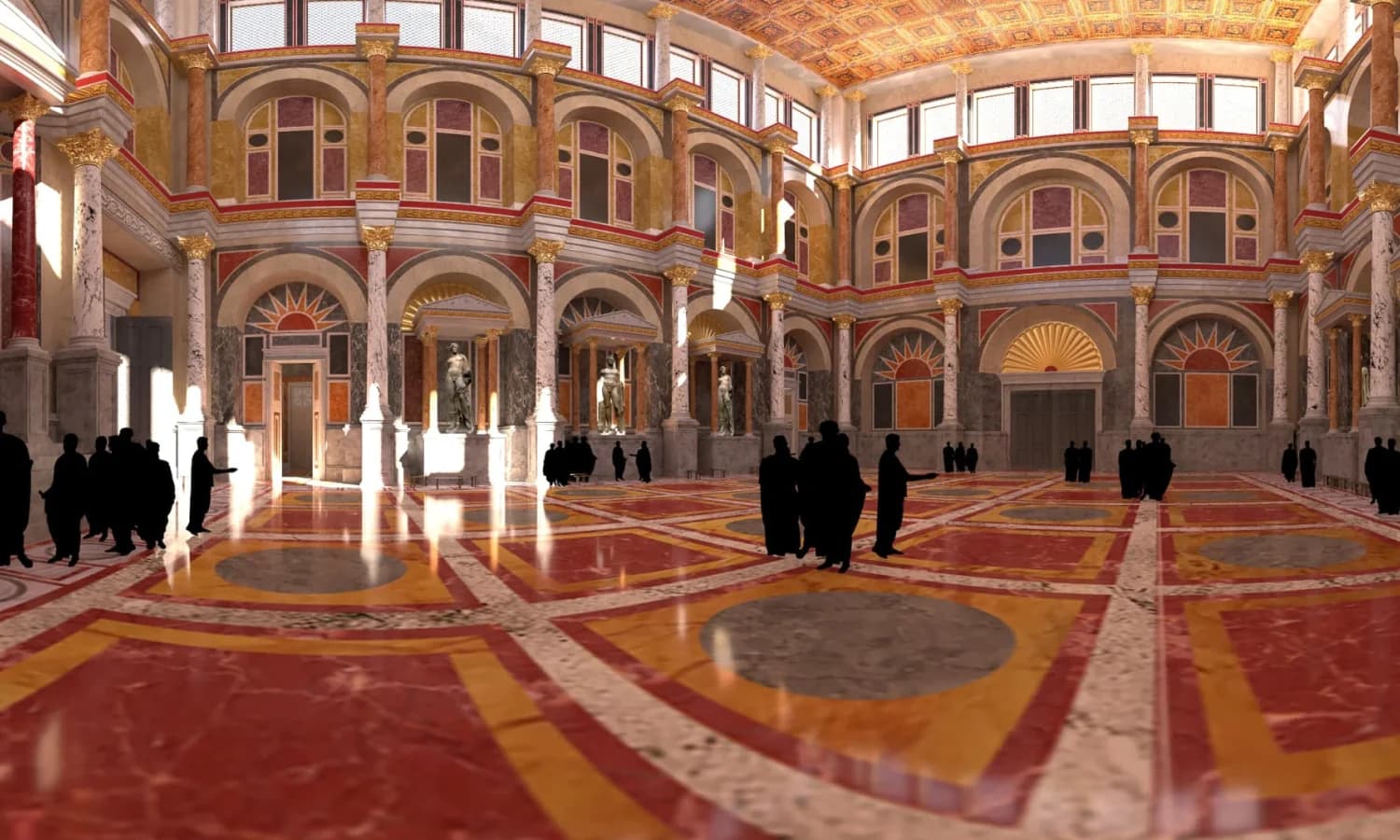
A few steps up from the great courtyard of Domitian's Palace lies Domitian's dining hall, known to the Romans as the Cenatio Iovis, the dining room of Jupiter, king of the gods. The name alone tells you what kind of evenings Domitian meant to hold here, and TimeLens's 360° reconstruction lets you see one of them in full.
A Room Built Around a Throne of Its Own
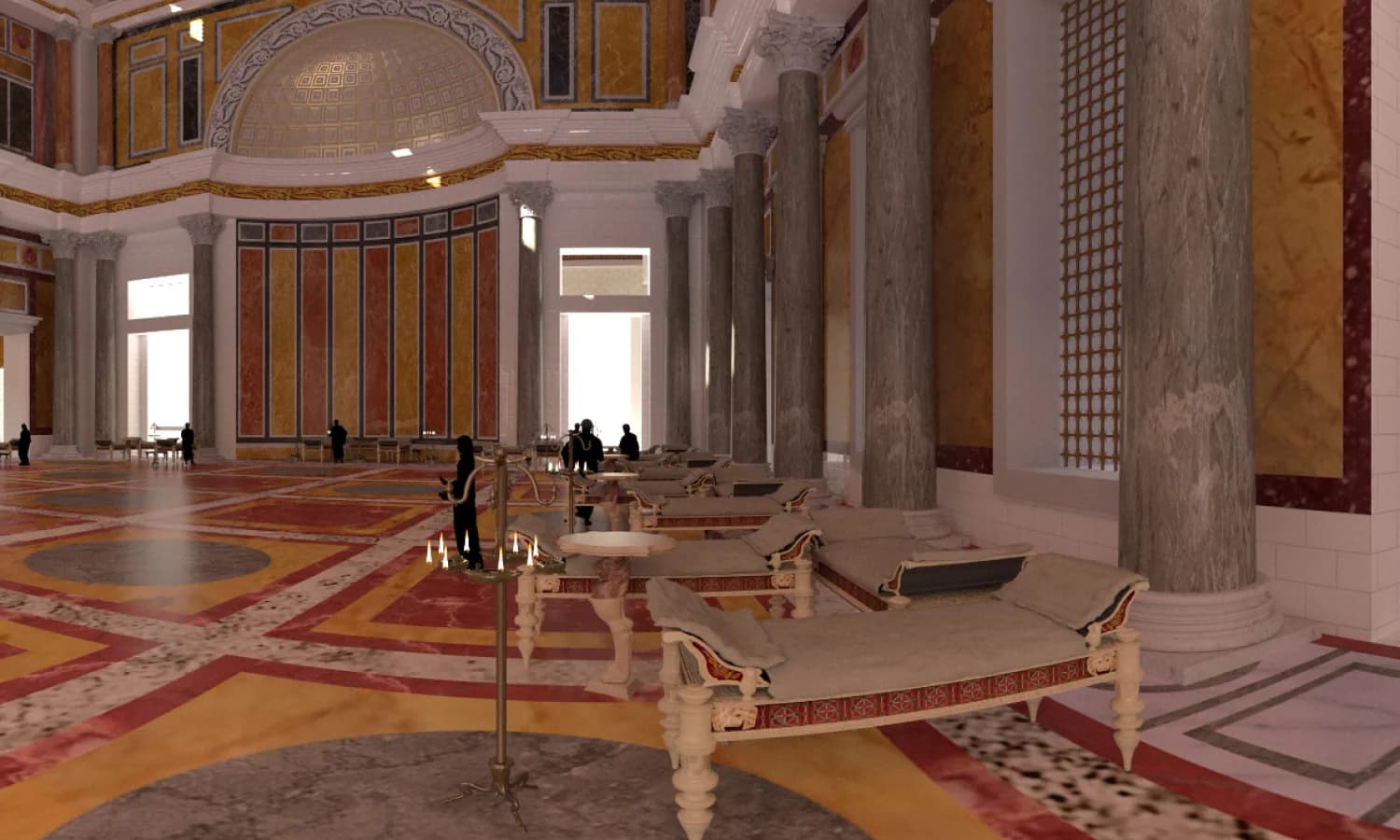
The hall rises high overhead, with rows of windows near the top letting in daylight. At the far end, the wall curves back into a deep, rounded recess crowned with a half dome. This apse held the tables of the emperor and his most important guests, and everyone else in the room looked towards it, much as an audience looks towards a stage.
Romans did not sit upright to dine on occasions like this. They reclined on couches arranged in threes, forming a U shape around small round tables, and the floor itself records where each group belonged: its pattern divides into sections around the edges of the room, one for each set of couches. A guest's place in the room was a guest's place in the emperor's favour, and everyone present could see exactly where they stood.
A Floor Built From the Whole Empire
The floor is worth lingering over. Its great red panels, bands of golden yellow, and dark grey discs come from marble quarried in Egypt, mainland Greece, the island of Chios and Numidia in North Africa. Anyone crossing it walked over a map of Roman power laid out in stone. Even the columns are not quite what they seem: some are solid granite shipped from Egypt, others concrete clad in a thin skin of alabaster, near impossible to tell apart at a glance.
On both sides, the hall opened onto fountain courts, so that cool, moist air drifted in over the diners even during a Roman summer, while bronze candelabra lit the room as the evening wore on.
Feasting Among the Gods, or in Fear of Them
The poet Statius once dined at the emperor's table here and afterwards wrote a poem about the evening, comparing it to feasting among the gods. A different story, recorded by a historian writing more than a century later, describes a far darker banquet: Domitian, it is said, once invited Rome's leading men to a dinner where everything was black, the walls, the couches, the dishes, with each guest's place marked by a slab like a gravestone bearing his name. The guests reportedly spent the whole evening in silent terror, certain they would not live to see morning, only to be sent home unharmed at the end, each with a gift. Whether the story is exactly true or not, it tells you how the men who dined with Domitian came to see him. His hospitality could feel very much like a threat.
See the Cenatio Iovis for yourself in the TimeLens app, then see the fountain rooms next door that kept it cool. For more on Roman dining customs, see the Metropolitan Museum of Art's essay on the Roman banquet.