How Were the Hunebeds Built?
A single capstone on a Dutch hunebed can weigh as much as twenty tonnes. The people who lifted it had no machines, no metal tools and no wheels. So how on earth did they do it? For centuries the answer seemed so impossible that people simply blamed giants. The very word hunebed comes from an old term meaning giant's bed.
Stones carried by the ice
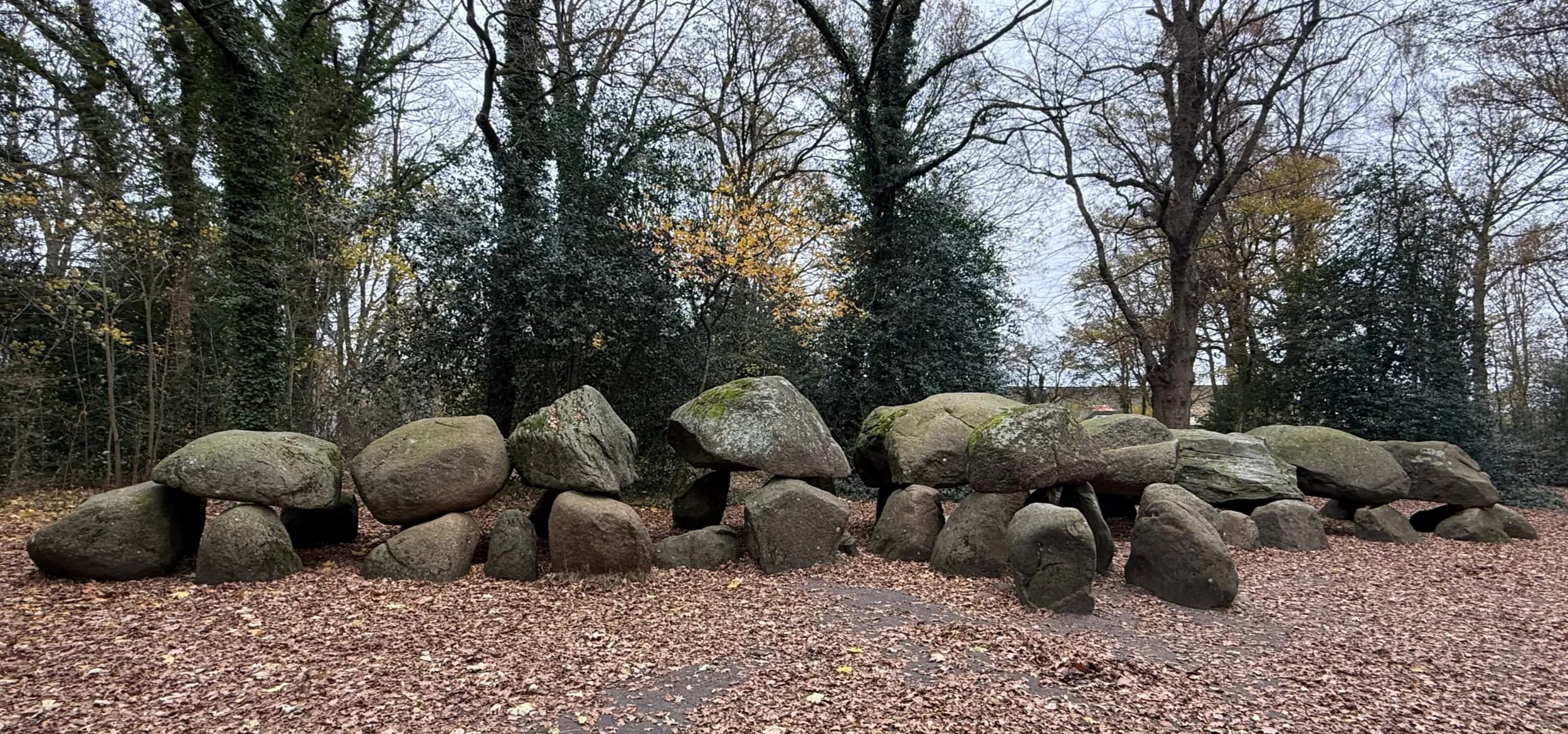
The builders did not quarry their stones. The great boulders, known as glacial erratics, had been carried all the way from Scandinavia by advancing ice during the ice age and dropped across Drenthe roughly a hundred and fifty thousand years ago. The farmers simply gathered what the landscape offered, sometimes digging a half buried boulder out of the sand before they could use it.
Moving the giants
To shift stones of this size, the builders relied on simple tools and many hands. Using levers, they raised each boulder onto wooden rollers or a sled, then hauled it across the land with ropes and sheer human effort, perhaps helped by oxen. It sounds far fetched, but experiments have shown it works: around thirty strong people, working together, can move these enormous stones in exactly this way.
Raising the roof
The hardest part was lifting the capstones into place. The leading explanation is that the builders set the upright stones first, then heaped up an earthen ramp against them. The heavy capstones could then be dragged up the slope and eased across the tops of the uprights. Once every stone was set, the gaps were packed with smaller stones, and the whole tomb was buried under a covering mound of earth, long since worn away. What looks today like a bare pile of boulders was once a smooth, hidden chamber.
Building a hunebed, step by step
This is exactly the moment TimeLens recreates. At the Hunebedcentrum you can witness a hunebed under construction, modelled on the real Hunebed D26 near Drouwen, with the rollers, ropes, ramps and crowds of workers all in motion. To meet the people who did this, and to stand before the largest hunebed they ever raised, read on. The reconstructions are made with the Hunebedcentrum in Borger.