The Palatine Hill Palace of Domitian: A Guide to Rome's Imperial Reconstruction
On the Palatine Hill in Rome stands the ruin of one of the ancient world's grandest buildings: the official palace of the emperor Domitian. With TimeLens, visitors can stand at fixed points among these ruins and see the palace as it looked when it was finished, in the year 92, through a series of 360° historical reconstructions produced with Learning Sites Inc.
A Palace for a Dynasty of Builders
Domitian was the youngest of the Flavians, a family that reshaped Rome. His father Vespasian took power in the year 69. His elder brother Titus ruled briefly after him. The Flavians built the Colosseum, formally called the Flavian Amphitheatre, and Domitian added to it further. Nero, emperor only a few years earlier, had built himself a vast private palace in the heart of the city, complete with an artificial lake on the site where the Colosseum now stands. The Flavians turned their backs on Nero's excess and built their own palace on the Palatine instead, on the spot where the first emperor, Augustus, had made his home.
The Palatine Hill gave the palace, and every palace since, its name. Romans called the hill Palatium, and so many rulers made their homes there that the word slowly came to mean the home of any ruler. English, and many other languages, inherited the word palace from this single hill.
Rabirius and the Shape of the Palace
The palace was designed by the architect Rabirius, who blended flat and curved surfaces in a way that was still new to Roman building, an approach later emperors such as Trajan and Hadrian would take much further. It was raised on a vast platform, about 150 metres long and 80 metres wide, laid across the dip between the Palatine's two summits, over the older houses of Augustus, his wife Livia, and, tradition held, the simple hut of Romulus himself.
The finished complex had two halves. The Domus Flavia was the official palace, where the emperor received visitors, held his audiences and hosted his banquets. The Domus Augustana, on two levels nearby, held his private rooms. Visitors in antiquity usually arrived by the Clivus Palatinus, the road climbing from the Forum past the Arch of Titus, a monument to Domitian's brother and his capture of Jerusalem in the year 70.
What TimeLens Shows You
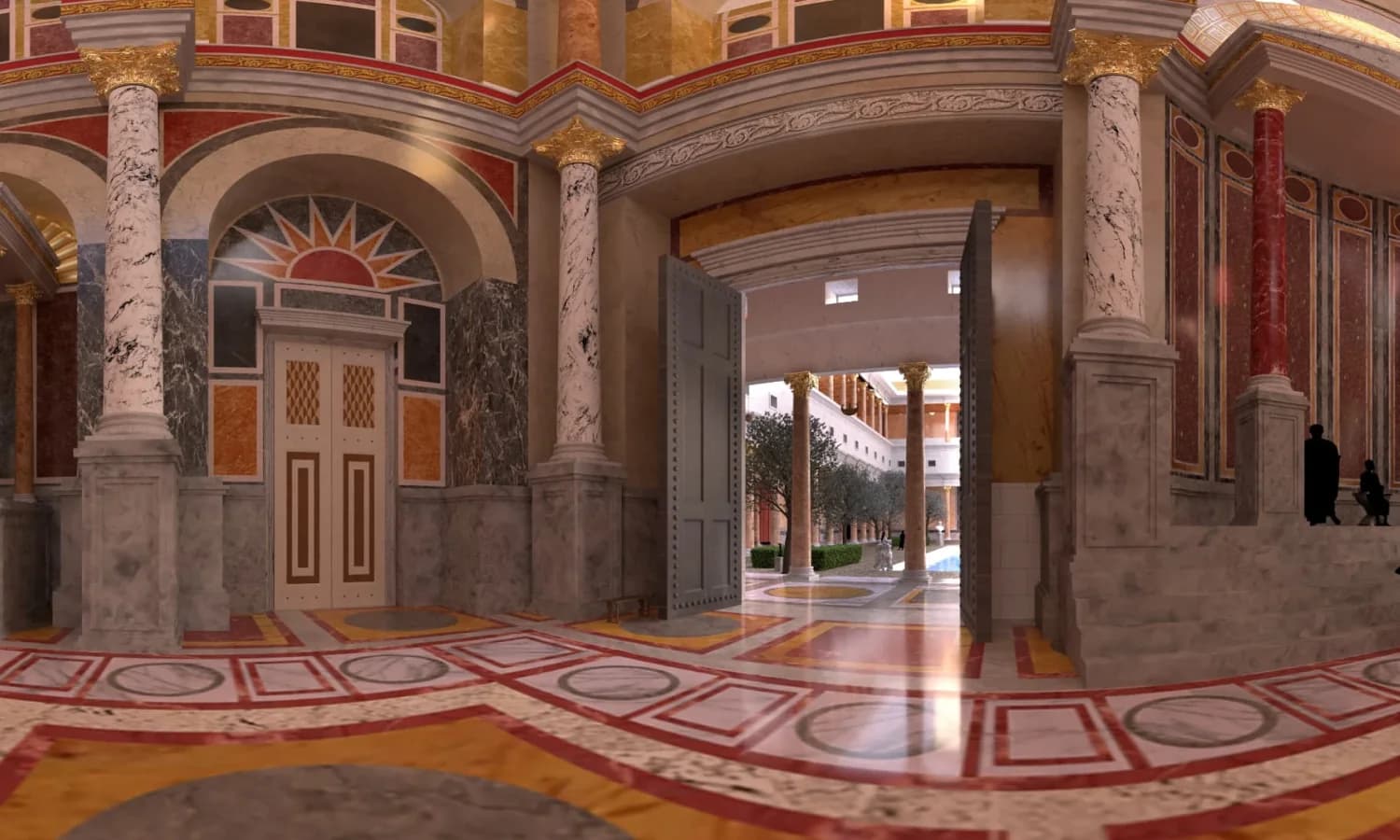
Each TimeLens reconstruction places you at a real spot within the ruins and shows the same view filled in with colour, marble, statues and people as ancient sources and archaeology describe them. Four rooms of the Domus Flavia are covered in detail in this series:
- The Aula Regia, the throne room where the emperor received ambassadors beneath a ceiling of gilded coffers.
- The Cenatio Iovis, the state dining hall where guests reclined on couches around marble floors gathered from across the empire.
- The fountain rooms that cooled the dining hall with nothing but moving water.
- The peristyle garden, the great courtyard at the heart of the palace, and the mirror wall that reveals just how uneasy Domitian's reign became.
Domitian did not enjoy his palace for long. In the year 96 he was murdered in his private rooms, in a plot that reached into his own household. The palace outlived him by centuries, home to emperor after emperor, until it fell into ruin. Today its marble is largely gone, some of it repurposed into churches and new buildings, some of it burned in kilns for lime. What remains is the plan of the rooms themselves, and it is this plan that TimeLens brings back into view.
You can see every TimeSpot in this Palatine Hill palace on our page about Domitian's Palace in Rome.
For the wider excavation history of the Palatine Hill, see the Parco Archeologico del Colosseo, which manages the site today.